
Cloud migration: 4 phases to do it safely
The only way to tackle a cloud migration in the best possible way is to understand exactly where your Company stands along the path.
Then the journey can be accelerated, safely and efficiently, but first of all you need to start from the basics, namely Analysis and Design.
Only after these preliminary steps will it be possible to proceed, in complete safety, to the Migration and to a subsequent Optimisation of the infrastructure.
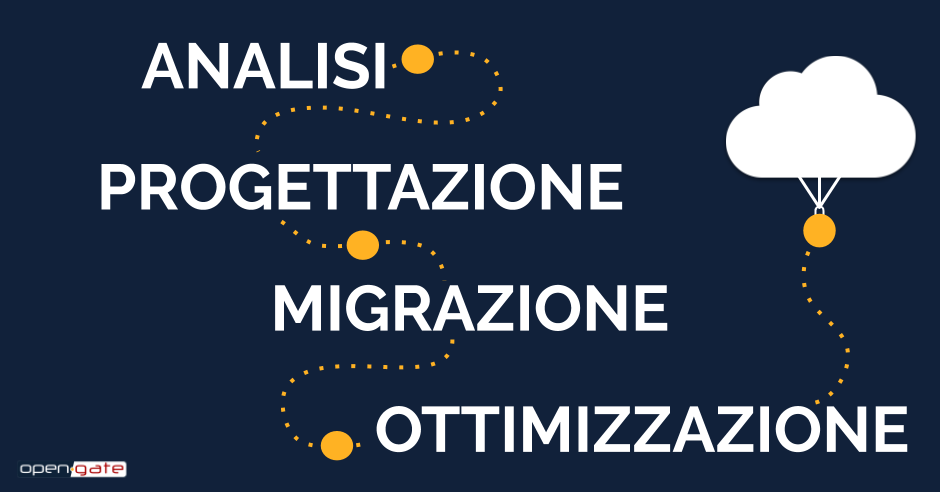
The journey will therefore be marked by 4 extremely important milestones:
- Analysis and assessment of the complete landscape of your business applications, data, critical issues...
- Design of the migration priorities and preparation of the project foundations
- The actual Migration, carried out in several successive Waves
- Optimisation of applications and activities to save on infrastructure costs and increase performance

ANALYSIS
The Analysis phase is necessary to assess the existing workloads that will have to be migrated and the information needed to determine the type of migration, the applications involved and the effort related to the migration.
The activities carried out aim to:
- Understand the requirements, the technical elements, the dependencies and the complexities around each application
- Gather information on the business-critical issues connected to each application, on the impact of the migration on its users, on the roadmap and on the most suitable strategy
- Classify and group the applications and use the milestones to estimate the overall effort of the migration

DESIGN
The Design phase is necessary to define the "landing" infrastructure on the cloud, to carry out the POC and validate the migration approach, and also to outline the long-term roadmap.
The migration candidates (applications, data...) will be ranked in order of priority, based on the business impact and the migration effort required.
In this phase the entire scope of the migration must be mapped out and split into Waves with a precise chronological order.
The migration will take place in successive Waves, at an increasing pace as the migrations progress and experience is gained on the specific project.
- Build the foundations for the migration by defining all the processes
- Determine the organisational structure and governance
- Split and plan the migration groups, defining the successive Waves
- Complete the Proof of Concept (POC) to validate the design produced

MIGRATION
Having defined all the Migration Waves in the previous phase, now it is just a matter of starting and following the schedule.
At the end of the first Wave it is essential to devote some time to verifying and validating the methodology. This verification has already been carried out during the POC phase, but a further check before proceeding to the next Waves is a must.
During this phase it is also possible to start a refactoring of the applications as they are migrated to the cloud.
A Migration with Change Factory phase can therefore be carried out (an approach based on software development that leads to significant innovation):
- It involves a complete rewrite or a significant modification of the applications
- It normally applies to small volumes of applications
- It focuses on the business value of the transformation brought by the cloud

OPTIMISATION
Migrating to the Cloud is not the last step of the roadmap. It is a starting point.
Now the Optimisation phase begins, carried out to improve processes, reduce infrastructure costs and to really start building business value.
A recent study by Rightscale estimated that about 35% of public cloud spending is wasted.
This is why, following a migration, it is absolutely necessary to devote yourself to an optimisation phase.
- Pre-migration sizing: automatic sizing of the cloud instances before the migration
- Configuration of the machine's CPU and RAM suited to your real needs
- Post-migration resizing: dynamic adjustment of the cloud instance resources after the migration
- Containerisation and adoption of Kubernetes: breaking down monoliths in favour of microservices
- Activation of any discounts based on sustained use of the machines or commitment
The success of a migration depends solely on the methodology followed to carry it out and on the experience accumulated by those performing it.
There are courses and certifications that allow you to arrive prepared to face a migration, but our recommendation is to never bite off more than you can chew.
Devote time to training and plenty of time to the Analysis and Design phases.
The Proof of Concept is essential, especially in the case of a first migration, and choosing the workload to migrate as the POC is just as crucial.
If you have doubts or concerns, devote more time to the documentation or ask for help from a Google Cloud Platform or Amazon Web Services Partner, who will be able to guide you along the way and will also be able to provide you with all the information you need to become independent at the end of the migration.