
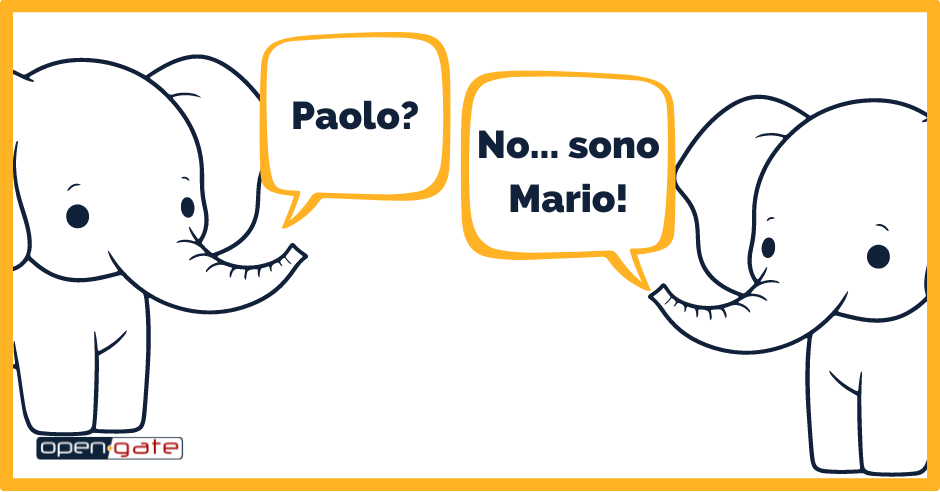
What if elephants called each other by name?!
Let's put it this way: we certainly don't wake up in the morning wondering whether elephants call each other by name, but knowing that they do... is extraordinary! When I read it, my immediate thought was: then I also want to understand what dogs say to each other... and dolphins, which apparently hold complex conversations!
But let's take a step back.
A research team at Colorado State University conducted a study on understanding the language of elephants. More precisely, the aim was to understand whether elephants call one another by name... using a unique sound, among many sounds, that identifies precisely their name.
The researchers analyzed the elephants' calls and discovered that elephants do indeed seem to recognize when they are called by name and respond accordingly.
Although it is not as sophisticated as human language, this discovery suggests that elephants possess complex cognitive abilities similar to those that led to the evolution of language in humans.
But how was this experiment carried out?
- Recording the calls: They recorded the elephants' calls in different social situations, including those directed at specific individuals.
- Analyzing the calls: They analyzed the elephants' calls looking for patterns and individual differences, using machine learning software and audio analysis.
- Playing back the calls: They played the recorded calls to different elephants, some of which were the original recipients of the calls, while others were not.
- Observing the reactions: They carefully observed how the elephants reacted to the calls. When the elephants heard a call directed at them, they approached the loudspeaker faster and emitted more vocalizations than when they heard calls directed at other elephants.
This suggests that elephants are able to distinguish between calls directed at them and calls directed at other individuals, even when they come from a loudspeaker and not from their usual social context. All this supports the idea that elephants can actually recognize names.
The discovery has profound implications for understanding the evolution of language, animal cognition and more...
The evolution of human language is a complex and mysterious process.
Studying animal communication, especially in species with advanced cognitive abilities such as elephants, can provide crucial clues about the precursors of language and the evolutionary pressures that led to its emergence.
This discovery opens important new avenues for future research. It will be essential to investigate how elephants learn and use these "names", whether regional dialects exist and how these abilities develop over the course of an elephant's life.
This also challenges the idea that human language is a unique and isolated phenomenon and suggests that similar abilities may be more widespread in the animal kingdom than previously thought.
But what technologies made it possible to better understand elephant communication and its similarities with human language?
In addition to digital audio recorders, which allow high-quality recordings capturing subtle variations in frequency and duration, and audio analysis software, which makes it possible to visualize and analyze the recorded sounds, such as spectrograms showing the sound's frequency over time and identifying patterns and differences in the calls... a fundamental role was played by machine learning algorithms, which make it possible to analyze large amounts of audio data and identify complex patterns.
In the case of elephants, machine learning algorithms can be "trained" to recognize calls directed at specific individuals, learning from the training data and improving their accuracy over time.
When we think of artificial intelligence, we think of LLMs and Generative AI and, by extension, of tools such as Gemini or Chat GPT or AIDeskPro... but LLMs are only one specific class of machine learning models, trained on enormous amounts of text data.
In reality, machine learning algorithms are at the heart of many AI applications, including the algorithms used to analyze elephant calls.
Where will we end up? What will we understand in the years to come thanks to AI? Hard to say... but I am confidently waiting to be able to talk with my dog, with a dolphin, or to understand the song of the whales...